Curtain Wall Details | Types & Glass Systems in Saudi Arabia

Many developers and consultants often overlook curtain wall details, treating them as secondary rather than critical technical choices. In Saudi Arabia’s harsh climate, this can lead to higher energy costs, water leakage, and maintenance issues. High temperatures, intense solar radiation, and strict building codes make the design complex. This article offers a clear, practical guide to curtain wall systems, showing how components connect and how informed decisions safeguard project value and long-term performance.
Table of Contents
What Are Curtain Wall Details?
Curtain wall details refer to the technical and structural specifications that guide the design, fabrication, and installation of curtain wall systems. As non-structural façades, every aspect, from mullions to glass, affects building performance and durability.
In the Saudi construction market, understanding curtain wall details is not optional. Local climate conditions require facades to manage heat gain, glare, and sand exposure while meeting Saudi Building Code requirements. Poor detailing can lead to air leakage, water infiltration, thermal bridging, and costly maintenance issues.
Why Curtain Wall Details Matter in Commercial Projects
For developers, architects, and project managers, accurate curtain wall detailing offers several advantages:
- Energy efficiency: Proper detailing reduces solar heat gain and cooling loads.
- Structural safety: Well-designed connections handle wind pressure on high-rise façades.
- Cost control: Clear details minimize variations and on-site modifications.
- Regulatory compliance: Correct detailing supports fire, acoustic, and thermal standards.
Looking to choose the best curtain wall types for your project? Contact us now via WhatsApp for quick, personalized advice.
Relationship Between Curtain Wall Types and System Details
Different curtain wall types require different detailing approaches. For example:
- Stick systems rely heavily on precise on-site assembly details.
- Unitized systems depend on factory-controlled tolerances and joint design.
- Semi-unitized systems combine both, requiring hybrid detailing strategies.
Each system changes how loads are transferred, how joints are sealed, and how glass panels are supported.
Curtain Wall Components Breakdown
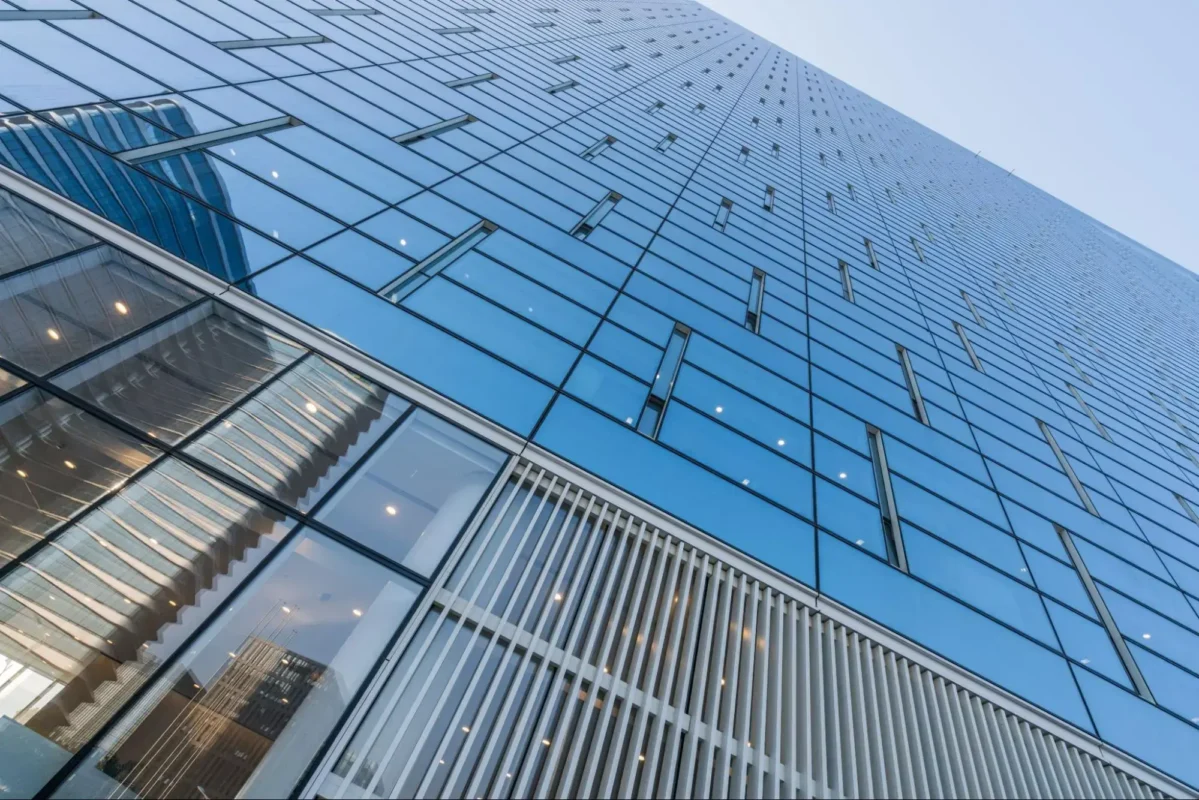
To fully understand curtain wall details, it is essential to examine the main components and how they function together as a complete facade system.
1. Aluminum Framing System
The aluminum frame forms the backbone of the curtain wall. It consists of vertical mullions and horizontal transoms that support the glass and transfer loads to the building structure.
Key detailing considerations include:
- Mullion depth and thickness based on wind load calculations
- Use of thermal breaks to limit heat transfer
- Surface treatments suitable for coastal or desert environments
In Saudi Arabia, aluminum profiles are often engineered to withstand high temperature fluctuations without warping or losing structural integrity.
Get a free consultation with our specialists to select the right curtain wall glass types and systems for your project.
2. Curtain Wall Glass Types
Glass selection is one of the most critical curtain wall details, as it directly affects energy performance and occupant comfort. Common curtain wall glass types include:
- Double-glazed insulated glass units for thermal insulation
- Low-E coated glass to reduce solar heat gain
- Laminated safety glass for impact resistance and fall protection
- Reflective or tinted glass for glare control and privacy
3. Anchoring and Fixation Details
Anchoring systems connect the curtain wall to concrete slabs or steel structures. These details are critical for structural safety and long-term performance.
Effective anchoring details address:
- Vertical and horizontal movement allowances
- Tolerance for building deflection
- Corrosion resistance in harsh climates
Improper anchoring is one of the most common causes of curtain wall failure, making this area a priority in technical reviews.
4. Sealing, Drainage, and Weatherproofing
Sealing details protect the building envelope from water and air infiltration. High-quality curtain wall details include:
- Multi-level gasket systems
- Pressure equalized joints
- Integrated drainage paths for condensation and rainwater
In Saudi Arabia, dust infiltration is also a concern, making airtight detailing especially important in commercial and healthcare buildings.
5. Thermal and Acoustic Performance Elements
Modern curtain wall systems must contribute to indoor comfort. This is achieved through:
- Thermal breaks within aluminum profiles
- Insulated glazing systems
- Acoustic seals at joints and interfaces
These details play a key role in meeting energy efficiency targets and enhancing occupant well-being, especially in office towers and hospitality projects.
Types of Curtain Wall Systems in Saudi Arabia
Understanding curtain wall details starts with selecting the right system type based on building height, site conditions, and performance requirements. The most common curtain wall types used in Saudi Arabia include the following:
1. Stick Curtain Wall System
Aluminum profiles and glass panels are installed and assembled onsite.
- Key Advantages:
- High flexibility for design modifications.
- Suitable for complex architectural shapes.
- Lower initial material cost.
- Best Used When:
- Projects are low to mid-rise.
- Site access allows extended installation time.
- Design changes may occur during construction.
- Key Detail Consideration: Precise sealing and alignment are critical to prevent air and water leakage.
2. Unitized Curtain Wall System
Complete facade panels are manufactured and glazed in the factory, then installed on-site.
- Key Advantages:
- Superior quality control and consistent curtain wall details.
- Faster installation and reduced on-site labor.
- Excellent performance against wind loads and thermal movement.
- Best Used When:
- Buildings are high-rise or large-scale.
- Tight construction schedules are required.
- High performance and long-term durability are priorities.
- Key Detail Consideration: Accurate coordination between structure tolerances and panel dimensions.
3. Semi-Unitized Curtain Wall System
Structural framing is installed on site, while glass panels are pre-glazed in the factory.
- Key Advantages:
- Balanced cost and performance.
- Faster installation than stick systems.
- Improved glass quality control.
- Best Used When:
- Medium to high-rise projects with budget constraints.
- A hybrid solution is needed between flexibility and speed.
- Key Detail Consideration: Joint detailing must accommodate movement and ensure watertight connections.
4. Point Supported (Spider) Curtain Wall System
Glass panels are fixed using stainless steel fittings with minimal visible framing.
- Key Advantages:
- Maximum transparency and modern aesthetics.
- Lightweight visual appearance.
- Best Used When:
- Entrance façades, atriums, and showcase areas.
- Architectural impact is a priority over insulation.
- Key Detail Consideration: Selection of laminated safety glass and accurate load calculations.
Across all systems, selecting suitable curtain wall glass types such as double-glazed, laminated, or Low-E glass plays a critical role in energy efficiency, safety, and acoustic comfort, especially under Saudi Arabia’s climate conditions.
Why Partner with Al-Samman for Your Curtain Wall Engineering?
High-performing facades require more than materials; they demand precise control of curtain wall details from design to execution. Al-Samman Group is recognized as one of the leading aluminum manufacturers in Saudi Arabia, with a proven track record that spans over five decades.
Since 1973, Al-Samman has delivered facade, aluminum, and glass works for major banking projects, including Al Rajhi Bank, Banque Saudi Fransi, Alinma Bank, and Bank AlJazira. These projects involved complete external facades, aluminum doors and windows, and advanced glass systems executed under strict performance and quality standards.
What sets Al-Samman Aluminum Factory apart is its integrated approach. The group operates specialized divisions for aluminum facades, ducting systems, electromechanical works, and woodworks, ensuring seamless coordination across disciplines. Combined with long term expertise, after-sales support, and guaranteed quality, Al-Samman offers reliable curtain wall solutions built for durability, performance, and long term value.
Conclusion
Understanding curtain wall details is essential for delivering facades that perform as well as they look. From selecting appropriate curtain wall types to specifying the right curtain wall glass types, each decision impacts cost, efficiency, and long-term value. In Saudi Arabia’s demanding construction environment, informed detailing is the difference between a facade that lasts decades and one that requires constant intervention.
Need expert guidance for your glass façade project? Message us directly on WhatsApp, and our team will provide a full analysis, suggest the perfect curtain wall types, and outline precise curtain wall details for your building.
Explore more:
Average Curtain Wall Installation Cost in Saudi Arabia 2026
Curtain Wall Glass Types: Common Options Used in Modern Facades
Structural Glazing vs Curtain Wall: Key Differences & Uses
FAQs about curtain wall details
What is meant by curtain wall?
A curtain wall is a non-structural exterior building envelope, typically made of aluminum and glass, designed to protect the interior from the elements without supporting the building’s weight.
Why do they call it a curtain wall?
It is called a curtain because it hangs from the building’s structural frame like a curtain, rather than resting on the foundation or supporting the roof.
What is the difference between a glass wall and a curtain wall?
A glass wall is a general term for any glass surface. A curtain wall is a specific engineered system that covers the building’s exterior and spans multiple floors on the building exterior.
What is the difference between a window wall and a curtain wall?
A curtain wall sits outside the floor slabs to create a continuous skin, while a window wall is installed between the floor slabs.